Nityas Gems & Jewellery IPO: GMP, Subscription Status, Review and Allotment Odds
Surat-based designer and maker of lab-grown diamond studded gold jewellery. Sells to jewellers and wholesalers, and runs 10 retail stores of its own through the Ayaani brand.
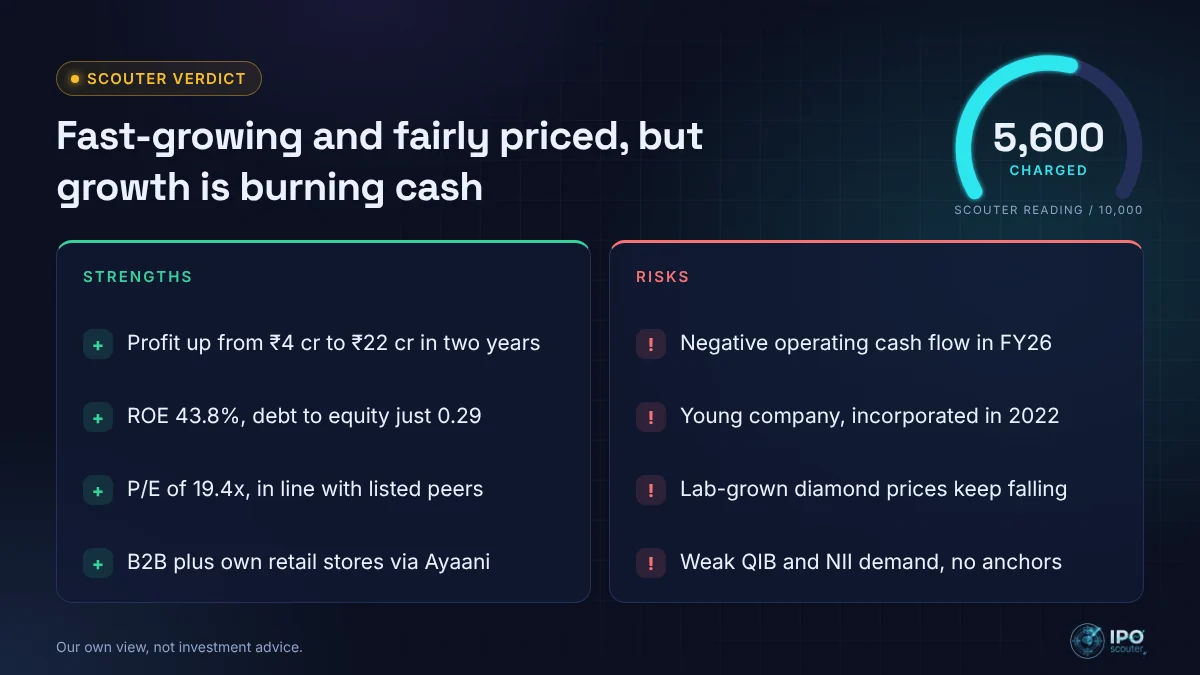
Fast growth, high returns and a price in line with listed peers. Held back by negative operating cash flow, a short track record and lukewarm institutional demand.
Our own view, not investment advice.
Subscription by category
Times subscribed. End of day 1 (30 Sep) and day 2 (1 Oct 2026)
GMP trend
Grey market premium in ₹ per share. Unofficial, sources differ
IPO timeline
Holiday alert: 2 Oct is a market holiday and 3 to 4 Oct is a weekend, so 5 Oct is the last and only remaining bidding day.
The Nityas Gems & Jewellery IPO is a bet on one idea: that Indian buyers will keep swapping mined diamonds for lab-grown ones. The company makes lightweight gold jewellery set with lab-grown diamonds in Surat, sells most of it to other jewellers, and recently picked up a small chain of its own stores. Its revenue has nearly quadrupled in two years.
The price looks reasonable for that kind of growth. At ₹75 a share the issue is valued at about 19.4 times FY26 earnings after the IPO, close to the average of listed jewellery peers. What holds us back is cash. The business reported a ₹22.3 crore profit in FY26 but burned ₹14.7 crore in operating cash, and big investors have so far stayed on the sidelines. Here is the full picture.
Nityas Gems & Jewellery IPO at a glance
| Detail | Nityas Gems & Jewellery IPO |
|---|---|
| Issue size | ₹108.35 crore (entirely fresh issue, no OFS) |
| Shares on offer | 1,44,56,000 equity shares |
| Price band | ₹70 to ₹75 per share (face value ₹5) |
| Lot size | 200 shares (₹15,000 at the upper band) |
| Retail maximum | 13 lots, 2,600 shares (₹1,95,000) |
| sHNI minimum | 14 lots, 2,800 shares (₹2,10,000) |
| bHNI minimum | 67 lots, 13,400 shares (₹10,05,000) |
| Quota | QIB 49.67%, Retail 34.76%, NII 14.90%, Employees 0.69% |
| Anchor round | None |
| Bidding dates | 30 Sep to 5 Oct 2026 (2 Oct is a market holiday) |
| Allotment | 6 Oct 2026 |
| Refund and demat credit | 7 Oct 2026 |
| Listing | 8 Oct 2026 on BSE and NSE |
| Market cap at upper band | About ₹433 crore |
| Promoter holding | 58.1% before the issue, 43.51% after |
| Lead manager | Choice Capital Advisors |
| Registrar | Bigshare Services |
One practical point first. With 2 October a market holiday and 3 to 4 October a weekend, Monday 5 October is the last bidding day. If you plan to apply, do it in the morning. UPI mandates pile up on closing afternoons and some of them fail to go through in time.
What Nityas Gems & Jewellery actually does
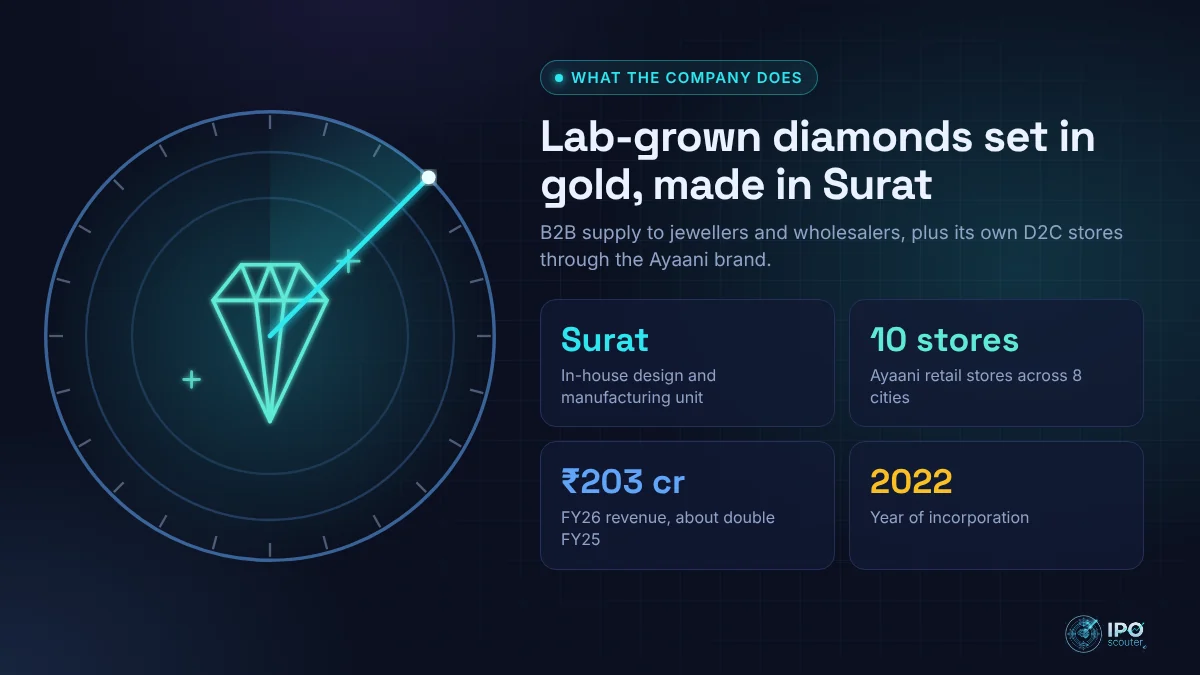
Nityas Gems & Jewellery Ltd was incorporated in April 2022 and is promoted by Rajnikant Lallubhai Chanchad, Sonalben Rajnikant Chanchad and Savaliya Dhruv Janakbhai. It designs and manufactures gold jewellery studded with lab-grown diamonds (LGDs) at its unit in Surat, the city that cuts and polishes most of the world’s diamonds. The range covers rings, earrings, pendants, bracelets, bangles, necklaces and mangalsutras, pitched as lightweight, affordable daily wear rather than heavy bridal pieces.
A lab-grown diamond is chemically the same as a mined one but is made in a reactor in weeks, so it sells at a fraction of the price. That is the whole pitch: a diamond look for a gold-jewellery budget. Design is done in-house on CAD/CAM software, and finishing is handled by the company’s own karigars.
The business runs on two legs. The bigger one is B2B: the company supplies finished pieces to jewellery retailers and wholesalers, who sell them under their own names. The second is direct-to-consumer. In 2025 it bought a 50.04% stake in Ayaani Diamonds and Jewellery, which runs 10 retail stores across 8 cities plus an online channel. That gives Nityas a brand of its own and a higher-margin retail outlet, but it also means part of the recent jump in revenue comes from adding a business it did not build.
The numbers behind the business
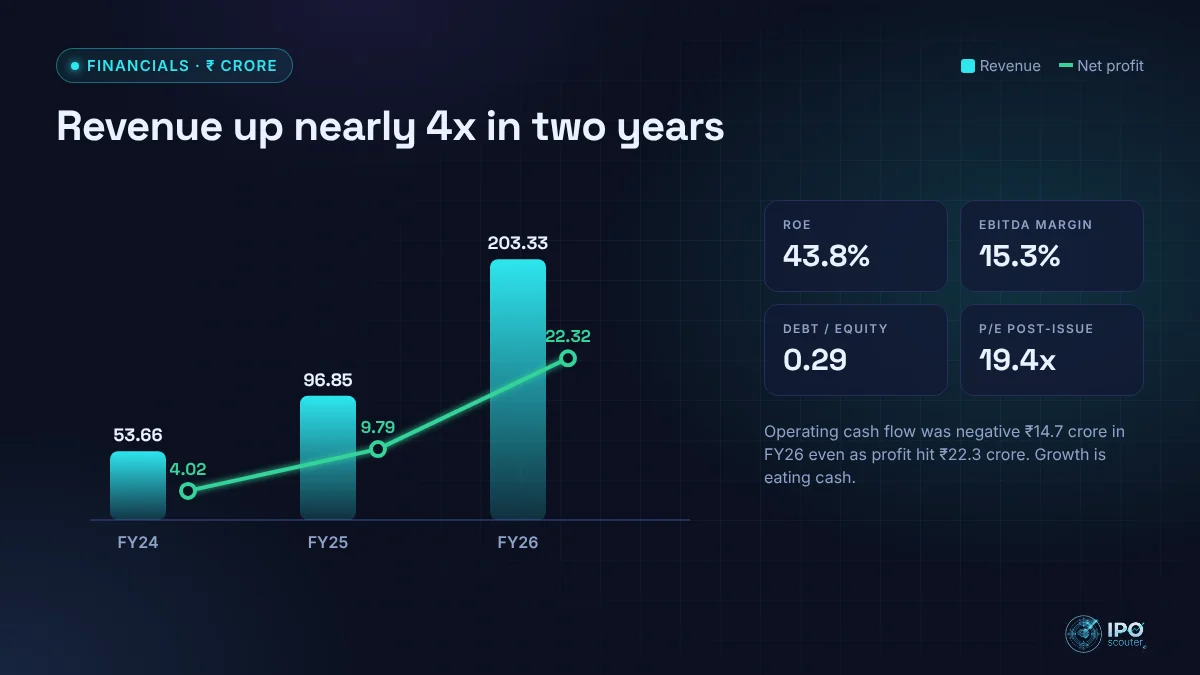
Here are the three years in the offer documents, in ₹ crore, restated and consolidated as reported by IPO data sites.
| ₹ crore | FY24 | FY25 | FY26 |
|---|---|---|---|
| Total income | 53.66 | 96.85 | 203.33 |
| EBITDA | 5.48 | 12.90 | 30.97 |
| Net profit | 4.02 | 9.79 | 22.32 |
| Net worth | 5.33 | 22.57 | 79.43 |
| Borrowings | 3.26 | 7.11 | 9.08 |
| Total assets | 11.75 | 39.87 | 116.42 |
What these numbers tell us, in plain language:
- Growth is fast and margins are widening. Revenue went from ₹54 crore to ₹203 crore in two years, and profit grew more than five times. EBITDA margin rose to 15.3% and net margin to 11%, which is high for a jewellery maker. Some of FY26’s growth reflects consolidating Ayaani after the 2025 stake purchase.
- Cash flow does not match profit. Operating cash flow was negative ₹14.7 crore in FY26, against a reported profit of ₹22.3 crore. Gold and finished stock sit in inventory, and trade buyers take time to pay. The company closed FY26 with just ₹0.54 crore in cash, which is why ₹70 crore of the IPO money goes to working capital.
- Returns will fall after the IPO. ROE of 43.8% and ROCE of 42.9% look superb, but they rest on a small equity base of ₹79 crore. Adding ₹108 crore of fresh money more than doubles net worth, so ROE on the post-issue equity would be closer to 12% at FY26 profit levels until earnings catch up.
- Debt is low. Borrowings were only ₹9.1 crore at the end of FY26, and debt to equity was 0.29. Balance-sheet risk is not the concern here; cash conversion is.
How the subscription is playing out, day by day
| Category (share of issue) | Day 1 (30 Sep) | Day 2 (1 Oct) |
|---|---|---|
| QIB (49.67%) | 0.00x | 0.38x |
| NII (14.90%) | 0.11x | 0.27x |
| Retail (34.76%) | 0.52x | 1.31x |
| Employees (0.69%) | 0.53x | 0.95x |
| Total | 0.20x | 0.69x |
Retail investors are carrying this issue. The retail book crossed full subscription on day 2 and closed the day at 1.31x. Institutions are the weak spot. QIBs have half the issue reserved for them but bid for only 0.38x by the end of day 2, and the NII portion stood at 0.27x. There was no anchor round either, so no fund put money in ahead of the opening.
QIB books often fill on the final day, so 0.38x is not a verdict yet. But with half the issue in that bucket, the final QIB number will decide whether the overall issue is comfortably covered. Day 2 figures are the latest available because 2 October was a holiday. We will add the day 3 numbers on 5 October.
The GMP story so far
The grey market has cooled. GMP was about ₹9 on 29 September, the day before the issue opened. It slipped to ₹5 on the opening day and has held at around ₹3 since 1 October, including the latest reading on 4 October. At ₹3 the grey market implies a listing near ₹78, a gain of about 4% over the upper band.
Our reading: a falling GMP during the bidding window usually means early optimism has faded, not that the issue is in trouble. Still, a 4% premium leaves very little cushion if broader markets dip in the week of listing.
The listing outlook
Shares are due to list on BSE and NSE on 8 October 2026. A GMP of ₹3 points to a listing price of about ₹78, roughly 4% above ₹75. Three things will move it from here: the final QIB subscription, how retail demand holds up on the last day, and the general mood in small and mid-cap stocks that week.
Because there are no anchor investors, there is no lock-in for any pre-IPO institutional holder, and the entire fresh issue can trade from day one. That tends to make listing-day prices more volatile in both directions. We would treat any listing gain here as a bonus rather than the main reason to apply.
Why big investors are holding back
Cash flow is the weak link
For a jewellery company, profit is only half the story. Gold has to be bought upfront, and trade customers pay later. Nityas grew revenue by about 110% in FY26 but generated negative operating cash flow, which suggests growth is being funded by working capital and fresh equity rather than by the business itself. Fund managers usually want to see at least one year where profits turn into cash.
A very short track record
The company was incorporated in April 2022, so it has just three full financial years of numbers, and the latest one includes an acquired retail arm. That makes it hard to judge how much of the growth is repeatable.
Lab-grown diamond prices keep falling
Lab-grown diamond prices have been falling as production capacity grows, in India and abroad. That helps volumes, because the jewellery gets cheaper, but it can squeeze the value of each sale and of unsold stock. The company itself flags LGD price swings, gold price swings and customer acceptance of lab-grown stones as key risks.
Concentrated customers and markets
By the company’s own disclosure, revenue depends heavily on a few B2B customers, and sales are concentrated in a handful of states. Losing one large buyer or a slowdown in one region could hit the numbers quickly.
Strengths and risks
Strengths
- Revenue up from ₹54 crore to ₹203 crore and profit from ₹4 crore to ₹22 crore between FY24 and FY26
- EBITDA margin of 15.3% and net margin of 11%, both improving each year
- ROE of 43.8%, ROCE of 42.9% and low debt (debt to equity 0.29)
- Post-issue P/E of about 19.4x, close to the roughly 19x average of Golkunda Diamonds, Goldiam International and Renaissance Global
- In-house design and manufacturing, plus its own retail brand through Ayaani
- Entirely fresh issue, so all the money goes into the company; no promoter is selling
- Positive notes from brokerages including BP Equities and Ventura, both of which said subscribe
Risks
- Negative operating cash flow of ₹14.7 crore in FY26 and only ₹0.54 crore of cash at year end
- Incorporated in 2022, so the track record is short, and FY26 includes the newly acquired Ayaani business
- Falling lab-grown diamond prices and volatile gold prices
- Dependence on a few large B2B customers and a handful of states
- Low brand recognition outside its own stores
- Weak QIB and NII demand so far, no anchor investors
- Promoter holding drops from 58.1% to 43.51% after the issue
- ROE will fall sharply once the IPO money is added to equity
Scouter verdict: A fast-growing, high-margin jewellery maker in a segment with real tailwinds, priced roughly in line with listed peers. We would score it higher if its profits were turning into cash and if institutions were showing more interest. Suitable for a small, long-term bet if you believe in lab-grown diamond adoption and can sit through a flat listing. Listing gains look modest at current GMP. This is our own view, not investment advice.
Your chances of getting an allotment
The retail quota is 50,24,600 shares, or about 25,123 lots of 200 shares. Under SEBI rules, each successful retail applicant gets at least one lot, and once the retail book is oversubscribed, lots are allotted by a random draw.
- At the day 2 retail figure of 1.31x, roughly three in four retail applicants would get a lot. That ratio will fall if retail demand rises on 5 October.
- If retail finishes at 3x, your chance drops to about 1 in 3.
- Applying for 13 lots instead of 1 does not improve your odds in the retail category. Applying through separate PANs in your family does.
- Employees have a separate reservation of 1,00,000 shares, which stood at 0.95x after day 2.
For sHNI and bHNI investors, the same draw method applies: each successful applicant gets the minimum application size (14 lots for sHNI, 67 lots for bHNI) once those portions are oversubscribed. As of day 2, the NII book was well below 1x.
What to watch from here
- The QIB subscription through the day on 5 October, the single biggest swing factor
- Whether retail holds above 1x and how far it climbs on the last day
- GMP on the evening of 5 October, and whether it recovers from ₹3
- Allotment status on 6 October through Bigshare Services or the BSE and NSE sites
- After listing: operating cash flow and inventory in the first results, and how quickly the Ayaani stores grow
We will update this page with the final subscription numbers on 5 October and again after listing.
Nityas Gems & Jewellery IPO: frequently asked questions
The price band is ₹70 to ₹75 per share with a lot size of 200 shares. At the upper band, one lot costs ₹15,000 and the retail maximum of 13 lots costs ₹1,95,000.
The issue was subscribed 0.20x on day 1 and 0.69x by the end of day 2 (1 October 2026), with retail at 1.31x, QIB at 0.38x and NII at 0.27x. The issue closes on 5 October 2026.
The grey market premium was about ₹3 on 4 October 2026, roughly 4% over the upper band. It was ₹9 on 29 September and ₹5 on 30 September. GMP is unofficial and can change quickly.
Based on a GMP of about ₹3, the implied listing price is around ₹78 against the issue price of ₹75. Listing is due on 8 October 2026 on BSE and NSE. This is an estimate, not a forecast.
Allotment is expected on 6 October 2026. You can check it on the Bigshare Services website or on the BSE and NSE allotment pages using your PAN or application number.
About ₹70 crore of the ₹108.35 crore fresh issue will fund working capital, and the rest goes to general corporate purposes. There is no offer for sale, so promoters are not selling any shares.
No. The issue has no anchor portion, so no institutional investor committed money before the issue opened.
Disclaimer: This article is for information and education only and is not investment advice. GMP is unofficial and data may differ between sources. Read the RHP and consult a SEBI-registered adviser before applying. Data as of 4 October 2026.
On this page
Key valuation
| P/E (pre-issue) | 14.5x |
| P/E (post-issue) | 19.4x |
| Peer P/E (avg) | about 19x |
| P/B | about 5.0x |
| Debt to equity | 0.29 |
| EBITDA margin | 15.3% |
| Anchor money | Nil |
IPO alerts
Get GMP moves, subscription updates and allotment links the moment they change.
Telegram channel launching soon