Acevector (Snapdeal) IPO: Listing Price, Performance and Review
Parent of the Snapdeal value e-commerce marketplace, e-commerce enablement software (Shipway, Convertway) and a portfolio of consumer brands under Stellaro.
Quick verdict: Acevector (Snapdeal) IPO is listed. Listing price: ₹28.32, -11.5% on NSE and BSE. Price band: ₹32. Final subscription: 5.07x, final, 29 Sep. Issue size: ₹420 cr. Scouter Reading: 2,900 (Base), a research score and not investment advice.
Scouter Reading v2 (8 Nov 2026): research case 3,200, −300 final subscription 5.07x = 2,900. Demand uses final exchange subscription, not GMP. The verdict below is our research view.
A familiar brand with narrowing losses and 32% revenue growth, but still loss-making and priced at over 14 times book value. It listed 11.5% below the issue price.
Our own view, not investment advice.
Subscription by category
Final subscription, 29 Sep 2026
Listing day and key numbers
NSE and BSE, listed 5 Oct; financials FY26, restated consolidated
| Issue price | ₹32 |
| Listing open | ₹28.32 (-11.5%) |
| Day 1 close | ₹26.08 (-18.5%) |
| Latest, 8 Oct | ₹31.09 (-2.8%) |
| Total income | ₹537.67 cr |
| Net loss | ₹45.51 cr |
| Revenue growth | 32% |
| Price to book | 14.5x |
| Pin codes served | 18,972 |
| Anchor money | ₹189 cr |
IPO timeline
Allotment was finalised on 30 Sep and refunds and demat credits went out on 1 Oct. Shares listed on 5 Oct at ₹28.32, 11.5% below the issue price.

Snapdeal IPO overview
A decade ago Snapdeal was one of India’s biggest online marketplaces. Its parent, Acevector, has now returned to the market with a ₹420 crore IPO built around a leaner business: the Snapdeal value marketplace, e-commerce software for sellers, and a portfolio of consumer brands. The issue was subscribed 5.07 times, with HNIs most enthusiastic.
Ahead of the 5 October debut, the grey market premium was only about ₹1, pointing to a near-flat start. The company was still loss-making, though losses have narrowed sharply.
How Acevector (Snapdeal) listed
| Detail | Value |
|---|---|
| Issue price | ₹32 |
| Listing price (NSE and BSE) | ₹28.32 (-11.5%) |
| Listing day close | ₹26.08 (-18.5%) |
| Latest price, 8 Oct | ₹31.09 (-2.8%) |
| One lot | 468 shares, ₹14,976 |
| Value at listing day close | ₹12,205.44 (loss ₹2,770.56) |
| Final subscription | 5.07x overall, retail 4.83x |
Acevector, the company behind Snapdeal, listed on 5 October 2026 at ₹28.32, 11.5% below its ₹32 issue price. Selling deepened through the first session and the stock closed at ₹26.08, down 18.5%. It has since recovered most of that ground and was at ₹31.09 on 8 October, about 2.8% below the issue price.
One lot of 468 shares cost ₹14,976. At the first day close it was worth about ₹12,205, a loss of roughly ₹2,771. At ₹31.09 the loss had narrowed to about ₹426 per lot.
A loss making brand meets a cautious market
The book was respectable rather than strong: 5.07x overall, with big NII at 9.33x, small NII at 6.94x, retail at 4.83x and QIB at 3.42x. The grey market had been signalling a quiet debut, with a premium of about ₹1 on 4 October. A discount at the open was more than that implied, but the direction was not a surprise for a company that is still loss making.
Our view has not changed. Acevector is a recognisable brand that is making real progress towards break-even, but it is not yet profitable and the IPO price was not cheap. The bounce from ₹26 suggests some buyers see value below the issue price. For holders, the quarterly path to positive operating profit is the number that matters most.
Acevector (Snapdeal) IPO at a glance
| Detail | Acevector (Snapdeal) IPO |
|---|---|
| Issue size | ₹420 crore (₹287 crore fresh + ₹133 crore OFS) |
| Issue price | ₹32 per share (face value ₹1) |
| Lot size | 468 shares (₹14,976) |
| Retail maximum | 13 lots (₹1,94,688) |
| Quota | QIB 75%, NII 15%, Retail 10% (as required for loss-making companies) |
| Anchor round | ₹189 crore on 24 Sep 2026 |
| Bidding dates | 25 Sep to 29 Sep 2026 |
| Allotment | 30 Sep 2026 |
| Refund and demat credit | 1 Oct 2026 |
| Listing | 5 Oct 2026 on BSE and NSE |
| Market cap at issue price | About ₹1,741 crore |
| Promoter group holding | 64.11% before, 49.96% after |
| Lead managers | IIFL Capital, CLSA India, Systematix |
| Registrar | MUFG Intime India |
Because Acevector is loss-making, SEBI rules required 75% of the issue to go to QIBs and only 10% to retail investors. With retail subscribed 4.83 times on a small quota, roughly one in five retail applicants received a lot.
What Acevector (Snapdeal) actually does
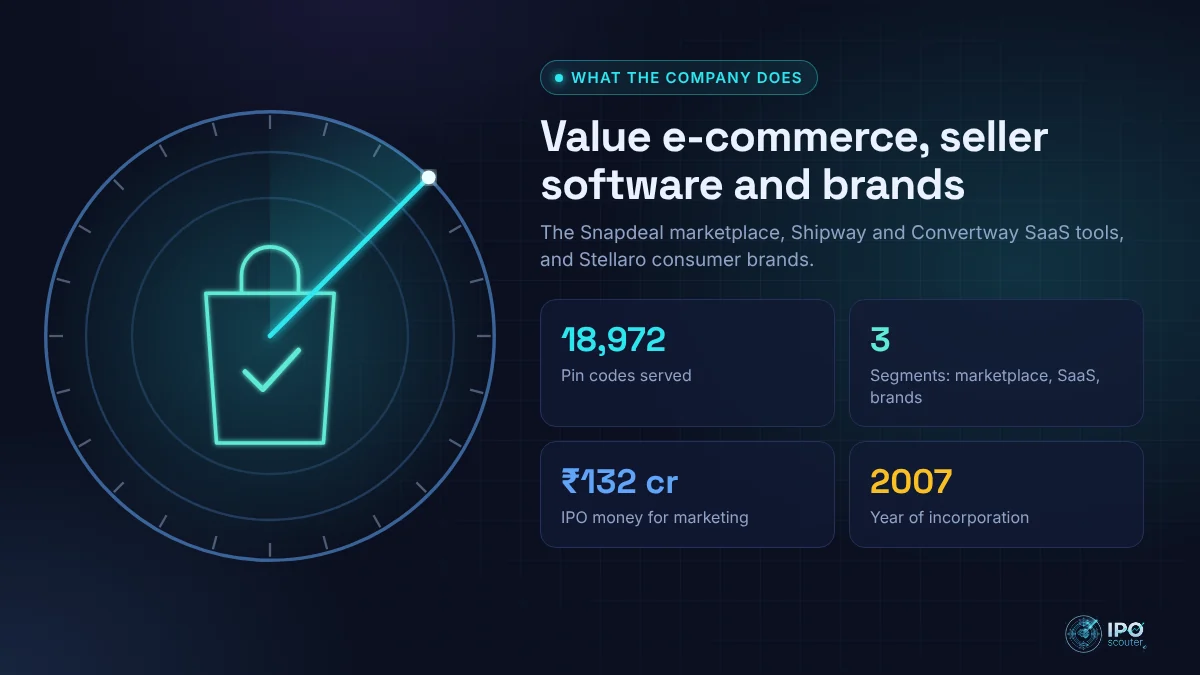
Acevector Ltd was incorporated in 2007. Its promoter group includes founders Kunal Bahl and Rohit Kumar Bansal and Starfish I Pte. It describes itself as an asset-light digital commerce ecosystem with three parts.
Snapdeal is a value-focused marketplace aimed at price-conscious shoppers in smaller towns, reaching 18,972 pin codes. The SaaS segment, including Shipway and Convertway, sells shipping, order management and conversion tools to online sellers. Stellaro Brands builds and acquires consumer brands sold online.
The fresh money goes to marketing and brand promotion (₹132 crore), technology (₹50 crore) and acquisitions (₹70.92 crore). The ₹133 crore OFS goes to existing shareholders.
The numbers behind the business
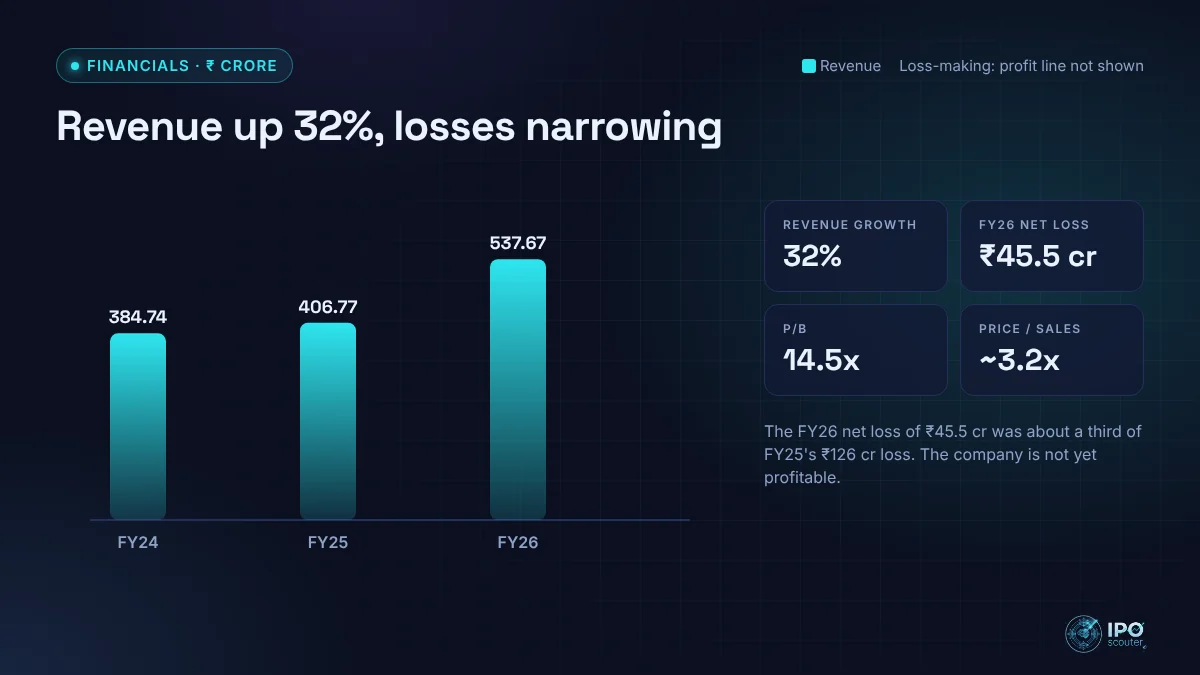
Here are the figures from the offer documents, in ₹ crore, as reported by IPO data sites.
| ₹ crore | FY24 | FY25 | FY26 |
|---|---|---|---|
| Total income | 384.74 | 406.77 | 537.67 |
| EBITDA | -35.77 | -107.79 | -22.17 |
| Net profit | -51.3 | -126.31 | -45.51 |
| Net worth | -142.09 | 126.33 | 102.08 |
| Total assets | 410.5 | 558.09 | 575.28 |
What these numbers tell us, in plain language:
- Revenue is growing again. Total income rose from ₹385 crore in FY24 to ₹407 crore in FY25 and ₹538 crore in FY26, a 32% jump in the latest year.
- Losses are shrinking. The net loss went from ₹51.3 crore in FY24 to ₹126.3 crore in FY25, then narrowed to ₹45.5 crore in FY26. EBITDA loss shrank to ₹22.2 crore.
- No P/E to speak of. With losses, the usual P/E does not apply. At about ₹1,741 crore market cap, the company is valued at roughly 3.2 times FY26 revenue and about 14.5 times book value.
- A debt-free balance sheet. Borrowings are negligible. Net worth turned positive in FY25 after a capital raise.
How the subscription ended
| Category | Final (29 Sep) |
|---|---|
| QIB | 3.42x |
| bNII | 9.33x |
| sNII | 6.94x |
| Retail | 4.83x |
| Total | 5.07x |
Big HNIs did most of the work when the issue closed on 29 September, bidding 9.33 times their quota. The rest of the book: QIBs 3.42x, small HNIs 6.94x and retail 4.83x, for 5.07x in total from 1,33,108 applications. Anchors had put in ₹189 crore on 24 September.
Acevector (Snapdeal) IPO GMP vs listing price
Grey market traders were paying about ₹1 on 4 October, around 3% over the ₹32 issue price. That pointed to a listing near ₹33. The stock opened at ₹28.32 instead. GMP is an unofficial grey-market quote, not a forecast.
How to check Acevector (Snapdeal) IPO allotment status
- Head to the allotment section on the MUFG Intime India website. The BSE or NSE allotment status page works too.
- Select Acevector (Snapdeal) as the company.
- Provide your PAN, application number or demat (DP and client) ID.
- Submit, and the page will show how many shares were allotted to you, if any.
Shares were allotted on 30 September 2026 and credited on 1 October, with refunds processed the same day. Listing followed on 5 October on BSE and NSE.
What we expected before listing
Before listing, a ₹1 grey-market premium pointed to a near-flat start around ₹33. The stock opened at ₹28.32, closed day one at ₹26.08 and recovered to ₹31.09 by 8 October. Anchor lock-ins run until 30 October for half of the anchor shares and 29 December for the rest.
What to weigh as a shareholder
Still losing money
Acevector lost ₹45.5 crore in FY26. Narrowing losses are encouraging, but the company has to prove it can turn profitable while spending ₹132 crore of IPO money on marketing.
A tough market
Value e-commerce is crowded, with giant rivals and well-funded social commerce players competing for the same price-conscious shopper. Snapdeal’s brand recognition is an asset, but not a moat.
Strengths and risks
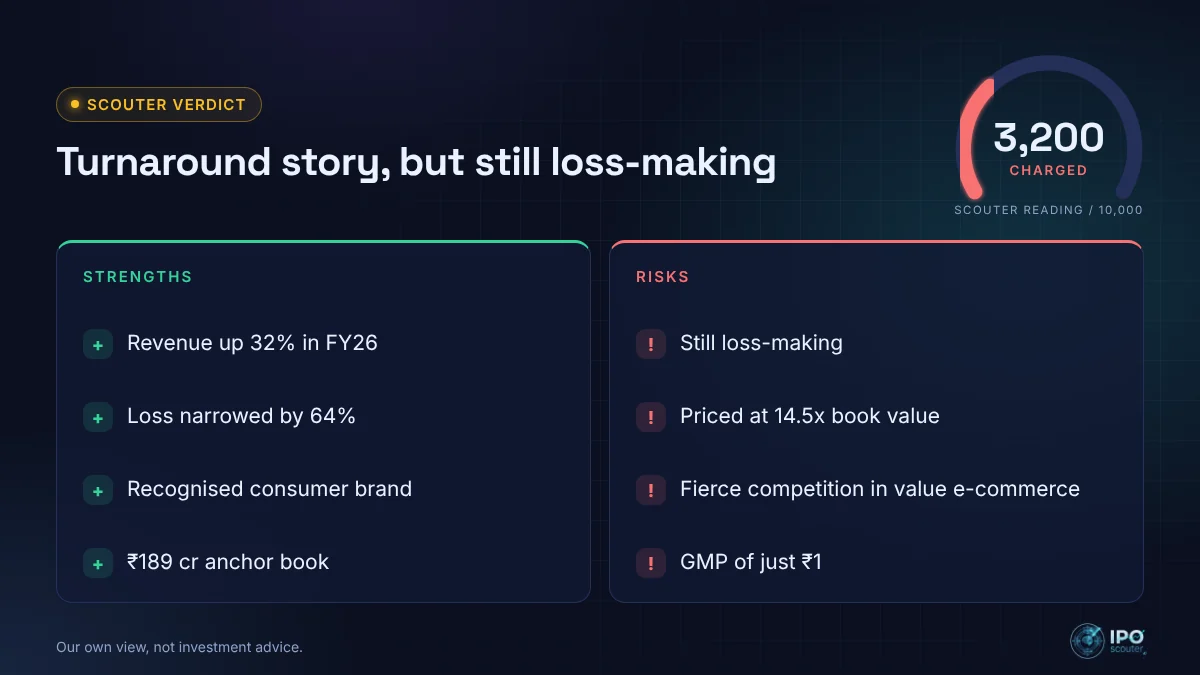
Strengths
- Revenue up 32% in FY26
- Net loss narrowed by 64% to ₹45.5 crore
- Recognised Snapdeal brand and reach across 18,972 pin codes
- SaaS and brands diversify revenue beyond the marketplace
- Anchor book of ₹189 crore; virtually debt-free
Risks
- Still loss-making
- Priced at about 14.5 times book value
- Intense competition in value e-commerce
- Existing shareholders selling ₹133 crore through the OFS
- Listed 11.5% below the issue price
- Retail allocation limited to 10% of the issue
Scouter verdict: A recognisable brand making real progress towards break-even, but still loss-making and not cheap. Its listing below the issue price fits that picture. This is our own view, not investment advice.
How Acevector (Snapdeal) IPO allotment worked out
- Retail investors were offered just 10% of the issue, about 28,045 lots of 468 shares. With retail subscribed 4.83 times, roughly one in five retail applicants received a lot.
- In a lottery the number of applications counts, not the number of lots per PAN.
What to watch from here
- Whether quarterly losses keep narrowing towards break-even
- Growth in the SaaS and brands segments
- How the ₹132 crore marketing spend translates into orders
- Anchor lock-in expiry: 30 October for half of the anchor shares, 29 December for the rest
Acevector (Snapdeal) IPO: frequently asked questions
One lot of 468 shares cost ₹14,976. At the listing day close of ₹26.08 it was worth about ₹12,205, a loss of roughly ₹2,771. At ₹31.09 on 8 October the loss was about ₹426.
Allotment was finalised on 30 September 2026. You can check it on the MUFG Intime India website or the BSE and NSE allotment pages using your PAN or application number.
Acevector (Snapdeal) listed on NSE and BSE on 5 October 2026 at ₹28.32, an 11.5% discount to the ₹32 issue price. It closed the first day at ₹26.08 and traded at ₹31.09 on 8 October.
The grey market premium was about ₹1 on 4 October 2026, suggesting a flat listing. The stock opened 11.5% below the issue price.
It was subscribed 5.07 times overall, with QIB at 3.42x, NII at 8.53x and retail at 4.83x.
No. It reported a net loss of ₹45.51 crore in FY26, narrower than the ₹126.31 crore loss in FY25.
Sources: MUFG Intime India (registrar) allotment page, BSE public issues, NSE IPO page, BSE allotment status, NSE allotment status, SEBI public issue filings (RHP). Subscription and price data are from the exchanges; financials are from the company’s offer documents.
Data as of 8 October 2026.
On this page
Key valuation
| P/E | n/a (loss-making) |
| Price to sales | about 3.2x |
| P/B | 14.5x |
| FY26 net loss | ₹45.5 cr |
| Revenue growth | 32% |
| Anchor money | ₹189 cr |
IPO alerts
Get GMP moves, subscription updates and allotment links the moment they change.
Follow @ipoScouter on X