
What is IPO GMP? Grey market premium explained
GMP is the most quoted number in every IPO conversation, and the most misunderstood. Here is what it really measures, how to read it and where it can lead you wrong.
Why everyone watches GMP
Open any IPO group on Telegram during a bidding week and you will see one number repeated more than the price band itself: the GMP. A ₹30 GMP gets people excited. Yet a GMP that drops from ₹30 to ₹8 in two days gets them nervous.
We track GMP for every IPO we cover, and we also see how often it misleads first-time applicants. Therefore, this guide explains what the number is, where it comes from and how we use it inside our Scouter Reading.
What IPO GMP means
GMP stands for grey market premium. It is the extra amount, above the IPO’s issue price, that buyers in the unofficial market are willing to pay for the shares before they list on the NSE or BSE.
If an IPO is priced at ₹105 and the GMP is ₹21, grey market buyers are effectively valuing the share at about ₹126 on listing day. A GMP of zero means no premium, and a negative GMP means buyers expect the stock to open below the issue price.
How the grey market works
The grey market is an informal network of dealers and traders who buy and sell IPO shares, or the rights to them, before the shares exist in anyone’s demat account. In other words, there is no exchange, no clearing house and no written contract. Instead, deals are settled in cash, usually on listing day, based on where the stock actually opens.
Two kinds of trades drive most of this activity:
- Premium trades: a buyer agrees to pay the issue price plus the GMP for shares the seller expects to receive. Then the seller sells the shares on listing day and the difference is settled between them.
- Application trades: a buyer pays for the right to an entire IPO application, whether or not it gets an allotment. This is where the terms kostak and subject to sauda come from.
Kostak and subject to sauda
You will often see two more rates quoted next to the GMP.
- Kostak rate: a fixed amount paid to the applicant for their application, whatever the allotment result. If the kostak is ₹500, the applicant keeps ₹500 even if they get nothing.
- Subject to sauda: an amount paid only if the application actually receives an allotment. It is higher than the kostak because the buyer takes no risk on a failed application.
Both rates rise and fall with the GMP, and both carry the same lack of protection as any other grey market deal.
How to read an IPO GMP number
Two simple calculations turn a GMP figure into something useful.
| What you want | Formula | Example (price ₹105, GMP ₹21) |
|---|---|---|
| Estimated listing price | Upper price band + GMP | ₹105 + ₹21 = ₹126 |
| Expected listing gain | GMP ÷ upper price band × 100 | ₹21 ÷ ₹105 × 100 = 20% |
| Expected gain per retail lot | GMP × shares in one lot | ₹21 × 142 shares = ₹2,982 |
However, the example is illustrative, not a real IPO. Always use the upper end of the price band, because that is where almost all retail bids are placed at the cut-off price.
Why GMP moves so much
GMP is a live reading of demand, so it reacts to news within hours. The biggest drivers we see are:
- Subscription numbers. Strong QIB demand on the final day often lifts GMP sharply. By contrast, weak institutional interest pulls it down.
- Market mood. A falling Nifty or a crowded IPO week cools the grey market quickly.
- Anchor book quality. Well-known mutual funds and foreign investors in the anchor round tend to support the premium.
- Issue size and float. Small SME issues have very few shares changing hands, so a handful of trades can move the GMP a lot.
- Sector theme. Hot themes such as defence, power or electronics often carry higher premiums than the numbers alone would justify.
How reliable is GMP?
GMP is a sentiment indicator, not a forecast. It tells you what a small group of traders thinks today, and it can change completely between the last bidding day and listing day.
Furthermore, it is least reliable in small SME issues, where volumes are thin and premiums can be quoted with very few real trades behind them. In addition, it varies across sources: two websites can show different GMPs for the same IPO on the same day. When sources disagree, we show the range rather than pick one number.
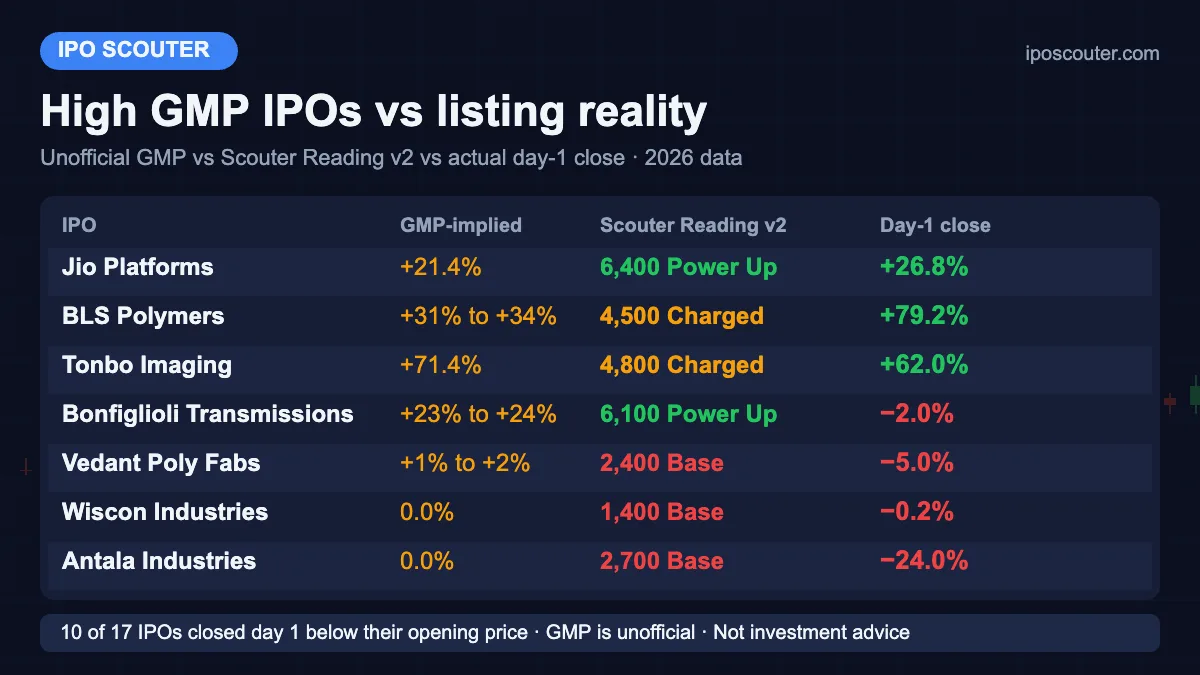
To see how close recent GMPs came to real listing prices, check our IPO GMP vs listing price tracker, which we update on every listing day.
Recent examples: GMP vs listing day (November 2026)
Three mainboard listings on 2 and 3 November show how loosely GMP tracks the real outcome. Grey-market figures below are unofficial dealer quotes; listing and closing prices are NSE data.
| IPO | Unofficial GMP before listing | NSE open vs issue price | Day-1 close vs issue price |
|---|---|---|---|
| BLS Polymers | ₹20 to ₹47 (sources varied widely) | +₹98 (+65.3%) | +₹118.80 (+79.2%) |
| SFC Environmental | About ₹15 to ₹18 | +₹25.10 (+7.6%) | +₹96.10 (+29.1%) |
| EAAA India Alternatives | Small and inconsistent | +₹10.50 (+0.6%) | +₹62.80 (+3.8%) |
The direction was right in all three cases, but the size was not: BLS Polymers and SFC both opened well above their grey-market quotes, and SFC kept rising to a 20% gain over its listing price by the close. That is why we treat GMP as a mood reading, never as a price target.
Is the grey market legal?
The grey market is not regulated by SEBI or the stock exchanges. Moreover, deals are informal, based on trust, and there is no investor protection, grievance process or guarantee that the other side will pay. If a deal goes wrong, you have no official route to recover your money.
IPO Scouter does not trade in the grey market and does not recommend it. Still, we report GMP only because so many investors follow it, and we always label it as unofficial.
How we use GMP in the Scouter Reading
We do not use GMP in the Scouter Reading at all. Under Scouter Reading v2, in force since 8 November 2026, unofficial grey-market quotes are never an input or a modifier in any IPO’s score.
The reason is simple. Grey-market quotes are unregulated, often thin and easy to move with a few trades. Different trackers also disagree, sometimes widely. As a result, a premium cannot carry the weight of a research score.
Instead, the Scouter Reading rests on four pillars from the RHP: financial trajectory and cash flow quality, valuation against listed peers, business model and concentration risk, and issue structure and use of proceeds. After bidding closes, we adjust it once for official NSE and BSE subscription demand. The full rules are on our Scouter Reading methodology page.
We still track GMP, separately and clearly labelled as unofficial. Our GMP Tracker dates every quote. Meanwhile, our GMP vs listing price tracker checks how each premium compared with the real listing.
Our high GMP IPOs study shows why a big premium often fades by the close.
A quick checklist before you trust a GMP
- Is the GMP rising, flat or falling over the last few days?
- Does QIB and NII demand support it, or is it mostly retail excitement?
- Is it an SME issue with a tiny float?
- Do different sources agree, or is there a wide range?
- Does the valuation make sense against listed peers?
- Would you still apply if the stock listed flat?
Frequently asked questions
What does GMP mean in an IPO?
GMP means grey market premium: the unofficial amount above the issue price that traders are paying for IPO shares before they list.
Does a high GMP guarantee listing gains?
No. GMP can fall sharply before listing, and stocks sometimes open below the issue price despite a positive GMP a few days earlier.
Can GMP be negative?
Yes. A negative GMP means grey market traders expect the shares to list below the issue price.
What is the difference between GMP and kostak?
GMP is a premium per share. Kostak is a fixed amount paid for a whole application, whether or not it gets an allotment.
Where can I see today’s GMP?
Our GMP Tracker lists the latest premium and trend for every open and upcoming IPO we cover. To see whether you got shares, read our guide on how to check IPO allotment status.
Disclaimer
This guide is for information and education only and is not investment advice. GMP is unofficial and unregulated. Read the RHP and consult a SEBI-registered adviser before investing. See our full Disclaimer.
Arjun Mehta is the editorial pen name of the IPO Scouter research desk. iposcouter.com is an independent website and is not registered with SEBI as a research analyst, investment adviser or stock broker.