Retail vs sHNI vs bHNI IPO Allotment Math: Why 4 Family PANs Beat a Single ₹2 Lakh Bid
Quick verdict: In an oversubscribed IPO, each retail application gets one lottery ticket, whatever its size. For BLS Polymers, four family PANs bidding one lot each (₹60,000 blocked) had about a 3.1% chance. One ₹1.95 lakh bid on a single PAN had about 0.8%.
sHNI vs bHNI IPO allotment becomes a real question once your bid grows past ₹2 lakh. The short answer: in a hot IPO, bigger bids rarely buy better odds. We used real subscription data from 2026 IPOs to compare retail, sHNI and bHNI routes. We calculated all odds below with the same method as our IPO allotment calculator.
However, these are estimates, not promises. The registrar’s basis of allotment sets the final result. Also, nothing here is advice to apply for any IPO.
How sHNI vs bHNI IPO allotment works
SEBI splits mainboard bids into categories. First, retail investors apply for up to ₹2 lakh. Next, small HNIs (sHNI) apply for more than ₹2 lakh and up to ₹10 lakh. Finally, big HNIs (bHNI) apply for more than ₹10 lakh. Within the non-institutional portion, one-third goes to sHNI and two-thirds to bHNI.
When a category is oversubscribed, allotment becomes a lottery. Specifically, each retail winner gets one lot. Similarly, each sHNI or bHNI winner gets the minimum application size for that category. A bigger bid inside the same category does not buy extra tickets, because the draw picks applications, not shares.
The sHNI vs bHNI IPO allotment formula we use
For one application, the chance is roughly 1 divided by the category’s subscription multiple. In addition, for several separate PANs, the chance that at least one wins is 1 − (1 − 1/x)N. For instance, at 128.36x with four PANs, that works out to about 3.08%.
sHNI vs bHNI IPO allotment odds: 2026 data
The table uses final subscription multiples from our reviews (Confirmed, exchange data). In addition, we calculated the odds and capital columns.
| IPO | Retail subscription | 1 retail PAN (any size up to ₹2 lakh) | 4 family retail PANs, 1 lot each | Capital for 4 PANs | sHNI, minimum bid | bHNI, minimum bid |
|---|---|---|---|---|---|---|
| BLS Polymers | 128.36x | 0.78% | 3.08% | ₹60,000 | Split not on our page; about 0.18% at the 559.20x NII average | Same caveat |
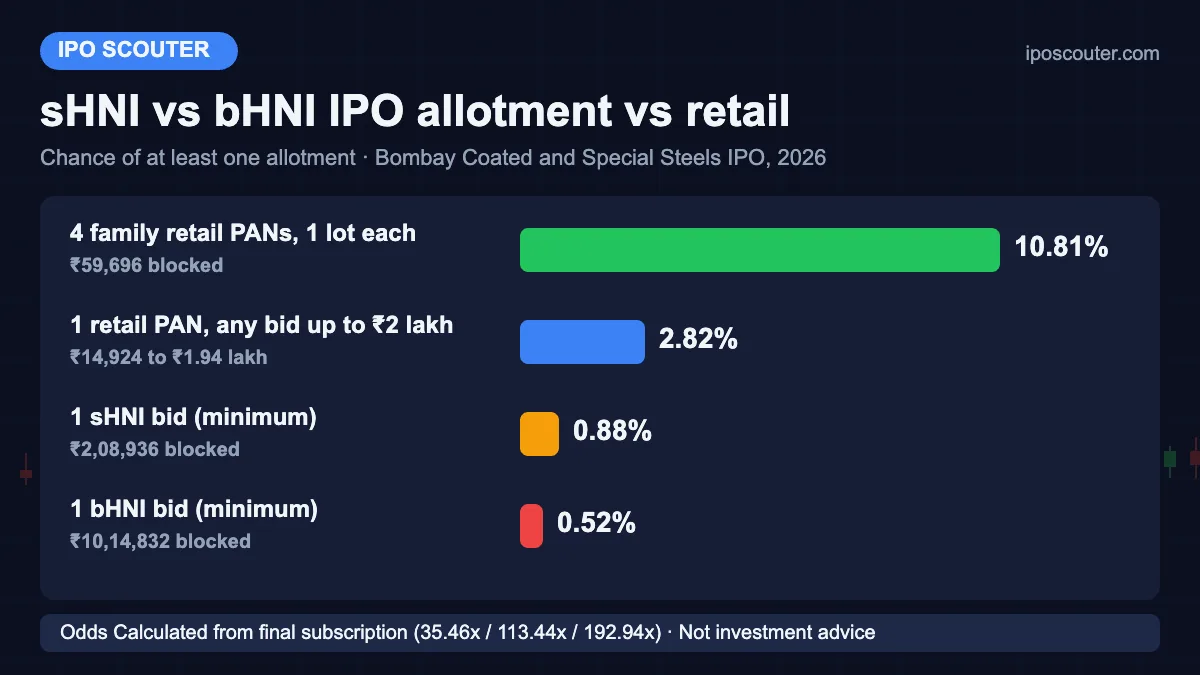
| Bombay Coated and Special Steels | 35.46x | 2.82% | 10.81% | ₹59,696 | 0.88% (113.44x; ₹2,08,936 blocked) | 0.52% (192.94x; ₹10,14,832 blocked) |
| Bonfiglioli Transmissions | 5.90x | 16.95% | 52.43% | Four one-lot bids | Split not on our page | Split not on our page |
| SFC Environmental Technologies | 2.71x | 36.90% | 84.15% | ₹59,400 | Split not on our page | Split not on our page |
| Paras Healthcare | 2.00x | 50.00% | 93.75% | ₹58,212 | Full allotment (0.80x) | Full allotment (0.59x) |
| EAAA India Alternatives | 1.08x | 92.59% | Above 99.9% | ₹59,940 | Split not on our page | Split not on our page |
Two patterns stand out. First, extra PANs help most when retail demand is very high. Second, when a category is undersubscribed, as at Paras Healthcare, every valid bid gets shares. In that case, a larger single bid simply gets more shares.
Why one ₹2 lakh retail bid is the weakest choice in a hot IPO
At BLS Polymers, a retail bid of 13 lots blocked ₹1,95,000. However, it still held one lottery ticket, the same as a ₹15,000 bid. Therefore, the extra ₹1.8 lakh bought no extra chance at all.
Moreover, moving up to sHNI does not fix this either. At Bombay Coated, the minimum sHNI bid blocked ₹2,08,936 for a 0.88% chance. Meanwhile, four family PANs with one retail lot each blocked ₹59,696 for a 10.81% chance. In short, that is about twelve times the odds for under a third of the money.
sHNI vs bHNI IPO allotment: when does a big bid make sense?
sHNI and bHNI bids can make sense in two cases. The first is an undersubscribed category, where every valid bid gets allotted in full. Alternatively, a big bid suits an investor who wants a larger allotment and accepts lower odds. Notably, bHNI odds at Bombay Coated were lower still, at 0.52%, with over ₹10 lakh blocked.
Blocked money also has a cost. After all, your bank holds it for about a week, from bid to allotment. Consequently, ₹10 lakh blocked for a 0.5% chance ties up savings that a family retail bid does not.
sHNI vs bHNI IPO allotment: a worked example
Bombay Coated and Special Steels is the cleanest example, because its sHNI and bHNI demand is on record. To begin with, its lot cost ₹14,924 at the upper band. Retail demand reached 35.46x, sHNI 113.44x and bHNI 192.94x (Confirmed).
First, take one investor with ₹2 lakh to spare. As a retail bidder, they can bid 13 lots and still hold one ticket, about a 2.82% chance. If they add a little and bid 14 lots, they move into sHNI. However, their chance then drops to about 0.88%.
Next, take the same family with four adults. Then each bids one retail lot from their own account. Together they block ₹59,696, and the chance that at least one wins is about 10.81%. In other words, the family route gives roughly four times the single retail chance for under a third of the money.
Finally, compare bHNI. A bid of 68 lots blocked ₹10,14,832 for about a 0.52% chance. So in this sHNI vs bHNI IPO allotment comparison, sHNI had better odds than bHNI, and both trailed retail.
Why sHNI vs bHNI IPO allotment odds are usually lower
NII demand often runs far ahead of retail demand in hot issues. For example, BLS Polymers drew 559.20x in the NII portion against 128.36x in retail. In addition, some large investors use IPO financing in hot issues, which can inflate demand. As a result, the sHNI and bHNI lotteries tend to be harder to win.
Besides, the minimum ticket also matters. Each sHNI winner receives the minimum sHNI bid, about 14 lots in these examples. Consequently, the category can serve fewer winners than retail, which hands out one lot each.
SME IPOs follow different rules
On SME platforms, individual investors apply for a minimum of two lots, worth over ₹2 lakh. For example, HGS (India) needed ₹2,88,000 per application at 232.80x individual subscription. One PAN had about a 0.43% chance, and four PANs about 1.71% (Calculated). In other words, the same logic applies, but each PAN needs far more capital. Our SME IPO hub lists current issues.
Rules for applying through family PANs
The family route works only when every application is a genuine, separate one. Therefore, keep these rules in mind.
- Each person needs their own PAN, demat account and bank account.
- Each application must come from the account holder’s own bank account or UPI ID. Registrars reject bids paid from a third party’s UPI ID.
- Each person decides and applies with their own consent and money.
- One PAN can make only one application per IPO in a category. The registrar rejects duplicate bids on one PAN.
Before you bid, check our upcoming IPO list. After the issue closes, our IPO allotment status hub and how to check IPO allotment status guide link each registrar.
Example: Crystal Crop Protection IPO (opens 18 November)
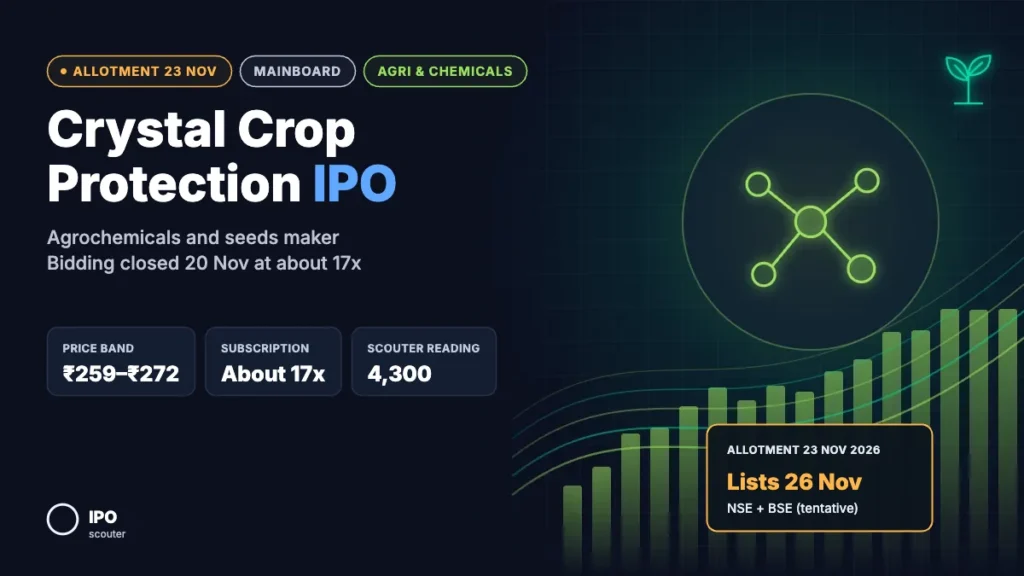
The Crystal Crop Protection IPO has a price band of ₹259–272 and a lot of 55 shares. Accordingly, one lot costs ₹14,960 at the upper band. As a result, four family PANs would block ₹59,840 in total (Calculated). Still, odds depend on final retail demand, which is not known until the issue closes on 20 November.
Also worth reading: why a big grey market premium often fades by the close, in our high GMP IPOs study.
sHNI vs bHNI IPO allotment: frequently asked questions
Not in a heavily oversubscribed IPO. At Bombay Coated, one sHNI bid had about a 0.88% chance, while one retail application had about 2.82%. Therefore, sHNI helps only when that category is undersubscribed.
No. In an oversubscribed retail category, each valid application gets one ticket in the draw. For example, a 13-lot bid has the same chance as a one-lot bid.
sHNI covers bids above ₹2 lakh and up to ₹10 lakh. bHNI covers bids above ₹10 lakh. sHNI gets one-third of the non-institutional portion and bHNI gets two-thirds.
Each family member can apply in their own name, from their own demat and bank account, with their own consent. However, you cannot bid for them from your account or UPI ID.
For one application, the chance is roughly 1 divided by the category’s subscription multiple. The registrar’s basis of allotment gives the final figure, so treat any estimate as approximate.
Disclaimer: This study is for information and education only. It is not investment advice or a recommendation to apply for any IPO. Odds are estimates; the registrar’s basis of allotment is final. This page contains clearly marked referral links (rel=”sponsored”); they never affect our Scouter Reading. Arjun Mehta is the editorial pen name of the IPO Scouter research desk. iposcouter.com is an independent website and is not registered with SEBI as a research analyst, investment adviser or stock broker. See our disclaimer.