Jio Platforms IPO Valuation vs Airtel: P/E, EV/EBITDA and ARPU
Data as of 20 October 2026, 22:00 IST. Confirmed = stated in the red herring prospectus (RHP) or company results. Reported = media, broker or data-provider figures. Calculated = our arithmetic, with the inputs shown.
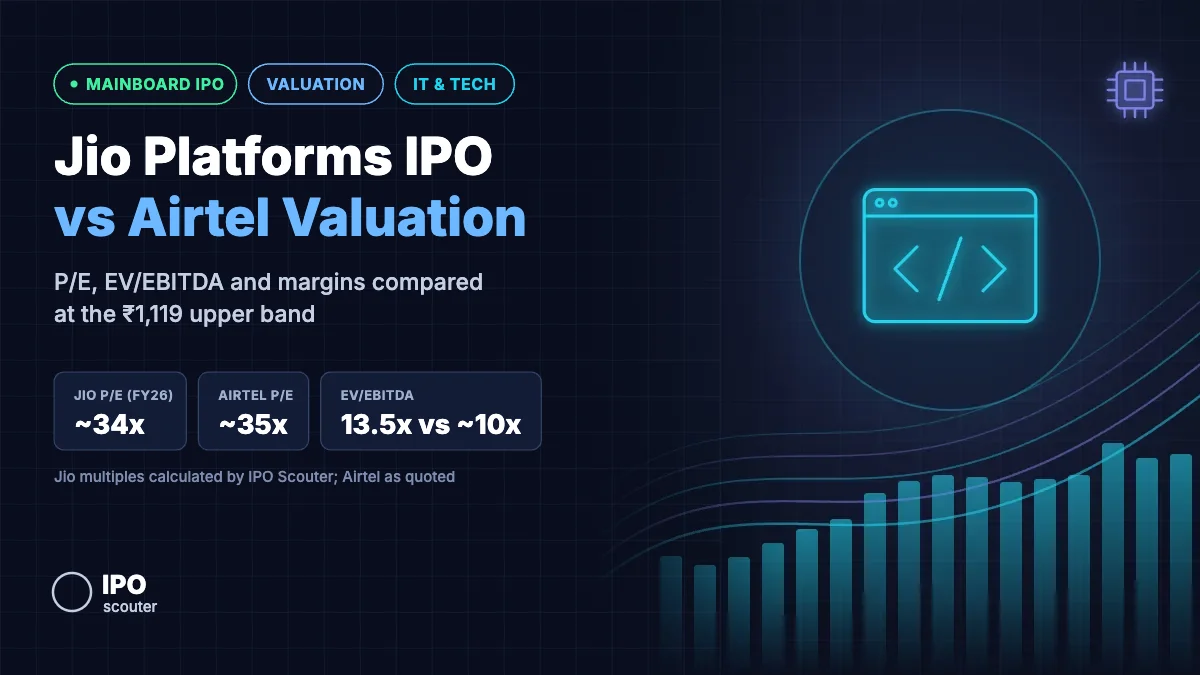
At the top of its ₹1,065 to ₹1,119 price band, Jio Platforms is valued at about ₹10.3 lakh crore, or roughly 34 times its FY26 profit of ₹30,064 crore. On price to earnings that puts it about level with Bharti Airtel, which data providers quote at about 35 times. On enterprise value to EBITDA, which strips out debt and accounts for Airtel’s higher margins, Jio comes out at a premium. Which comparison you lean on largely decides whether the issue looks fairly priced or rich.
Jio Platforms IPO valuation at a glance
| Measure | Jio Platforms (at ₹1,119) | Bharti Airtel (mid-October) | Basis |
|---|---|---|---|
| Market value | About ₹10.3 lakh crore | About ₹11.6 lakh crore | Reported (Business Today, Upstox, 15-16 Oct) |
| P/E, as quoted | About 34x FY26 | About 35x trailing | Calculated for Jio; reported for Airtel (INDmoney 35.4x on 12 Oct; Upstox 34-35x) |
| P/E on FY26 reported profit | About 34x | About 43x | Calculated: ₹10.3 lakh cr / ₹30,064 cr; ₹11.6 lakh cr / ₹26,904 cr |
| EV/EBITDA | About 13.5x FY26 | About 9.9x (10.3x India business) | Calculated for Jio; reported for Airtel (INDmoney, Motilal Oswal) |
| Net debt after the IPO | Close to zero | About 1.4x EBITDA | Calculated for Jio (₹27,579 cr net debt in March 2026, about ₹30,213 cr raised); reported for Airtel |
How the Jio figures are built: FY26 EBITDA is about ₹76,200 crore (51.9% margin on ₹1,46,885 crore revenue, both from the RHP). Net debt of ₹27,579 crore at 31 March 2026 is roughly cancelled by the ₹30,213 crore fresh issue, so enterprise value sits close to the ₹10.3 lakh crore market value, which gives about 13.5x. Brokers using their own definitions land higher: Emkay Global puts it at 15.0 to 15.6x FY26 EBITDA, and SBI Securities puts the post-issue P/E at 34.4x (both as reported by Business Today).
Jio vs Airtel: the FY26 numbers side by side
| FY26 (year to March 2026) | Jio Platforms | Bharti Airtel (consolidated) |
|---|---|---|
| Revenue from operations | ₹1,46,885 crore, up 14.6% (Confirmed, RHP) | About ₹2.1 lakh crore, up 22% (company results) |
| EBITDA margin | 51.9% (Confirmed, RHP) | About 55-58% for the year (reports differ); 57.8% in the March quarter |
| Net profit | ₹30,064 crore, up 15.1% (Confirmed, RHP) | ₹26,904 crore before exceptional items, up 53% (company results) |
| ARPU, March 2026 quarter | ₹214 a month | ₹257 a month (India mobile) |
| Active subscribers, August 2026 | 50.3 crore (41.7% share) | 48.7 crore (40.3% share) |
| Monthly data per customer | 42.3 GB | 31.4 GB (India mobile) |
| Return on capital employed | 10.8% | 19.1% |
Subscriber figures are TRAI data cited by ICICI Securities; data use and return on capital are as reported by Business Today. Airtel’s consolidated numbers include its Africa business and Indus Towers, so they are not a like-for-like match for Jio’s India-only operations. In the June 2026 quarter, Upstox reports Jio’s ARPU at ₹215 against Airtel’s ₹264, and Airtel’s India EBITDA margin at 57.4% against Jio’s 53.2%.
Why the P/E looks level but EV/EBITDA does not
Three things pull the two measures apart.
Debt. After the IPO, Jio is close to net debt free, while Airtel carries net debt of about 1.4 times EBITDA (reported). Debt adds to Airtel’s enterprise value but its interest cost also lowers Airtel’s profit, which lifts its P/E. Jio’s clean balance sheet works the other way.
Margins. Airtel turns more of each rupee of revenue into EBITDA (about 55-58% against Jio’s 51.9%) and earns almost twice Jio’s return on capital. Paying 13.5 times EBITDA for Jio against about 10 times for Airtel means paying more for each rupee of operating profit.
Which profit you use. Airtel’s quoted 35x is a trailing figure from data providers. On its reported FY26 profit before exceptional items, the multiple is closer to 43x (calculated). On that basis Jio at 34x looks cheaper, not level. Airtel’s profit grew 53% in FY26, so its trailing multiple falls quickly as newer quarters roll in.
What would close the gap: ARPU
Jio’s ARPU is about ₹43 a month below Airtel’s. As an illustration only, if Jio’s roughly 52.4 crore customers each paid ₹43.2 more a month, that would add about ₹27,200 crore a year in revenue, around 18% of FY26 revenue (calculated: ₹43.2 × 52.4 crore × 12). This is not a forecast. Tariff rises are uncertain, Jio’s subscriber mix is different, and higher prices can cost customers.
Analysts’ growth estimates are close. Motilal Oswal expects EBITDA to grow at about 15.2% a year for Jio and 14.6% for Airtel from FY26 to FY29 (as reported by INDmoney), and on its projected FY28 EBITDA puts Jio at about 12x. Business Today reported on 7 October that analysts expected Jio to seek a premium to Airtel, which is what the final band delivers on an EBITDA basis.
Risks to the comparison
- Different businesses. Airtel’s consolidated figures include Africa and tower assets; Jio Platforms also holds digital and enterprise businesses that do not show up in mobile ARPU.
- Moving share prices. Airtel’s market value changes daily, so every Airtel multiple here is a mid-October snapshot.
- Regulation and tariffs. Both companies depend on spectrum, licence terms and tariff decisions, which can move profits sharply.
- Estimates differ. Brokers define EBITDA and debt differently, which is why published Jio EV/EBITDA figures run from about 12x to 15.6x.
What this means for the Jio Platforms IPO
The issue is priced roughly in line with Airtel on earnings and at a premium on operating profit. The premium rests on Jio closing part of the ARPU gap while keeping its subscriber lead. The first public test of that view is demand from institutions in the main book, which opens on 21 October and closes on 23 October; the anchor round has already raised ₹8,109.85 crore at ₹1,119.
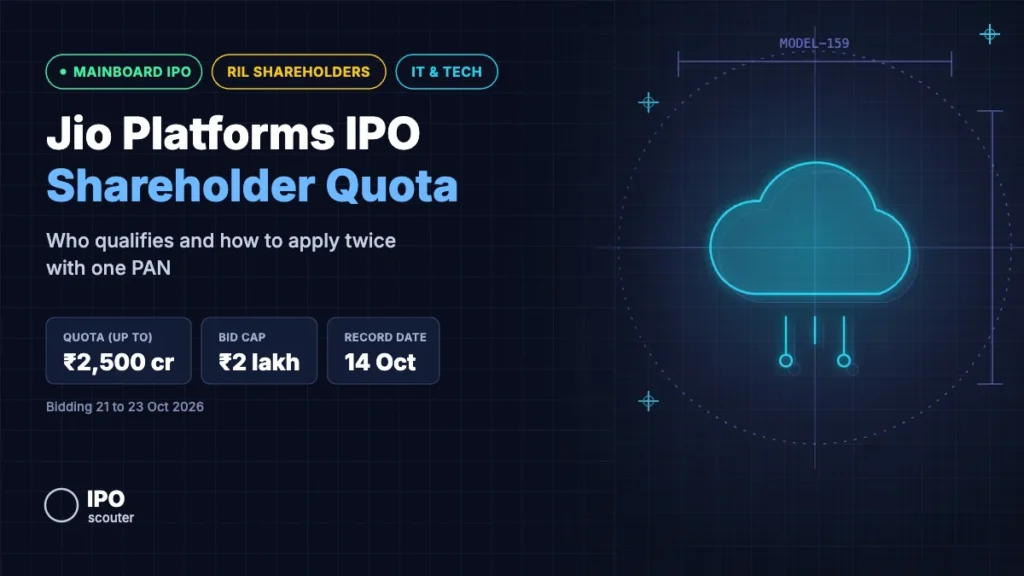
For the full review, price band, lot sizes and allotment dates, read our Jio Platforms IPO review, which also has a lot and amount calculator. If you held Reliance shares on 14 October, see how the RIL shareholder quota works.
Jio Platforms IPO valuation: FAQs
Is the Jio Platforms IPO overvalued compared with Airtel?
It depends on the measure. At ₹1,119 Jio trades at about 34 times FY26 profit, close to the roughly 35 times quoted for Airtel, but at about 13.5 times EBITDA against about 10 times for Airtel. Airtel has higher margins and returns on capital; Jio has lower debt and more subscribers.
What is the Jio Platforms IPO valuation at the upper price band?
About ₹10.3 lakh crore at ₹1,119 a share, as reported by Business Today, Upstox and INDmoney. That is about 34 times FY26 net profit of ₹30,064 crore.
How does Jio’s ARPU compare with Airtel’s?
In the March 2026 quarter Jio’s ARPU was ₹214 a month and Airtel’s India mobile ARPU was ₹257. In the June 2026 quarter Upstox reports ₹215 for Jio and ₹264 for Airtel.
Sources: Jio Platforms RHP, SEBI public issue filings; Business Today; Upstox; INDmoney; tele.net (Airtel FY26 results).
This page compares published valuation figures. It is not a recommendation to apply for, buy or sell any security. Read the RHP before investing.