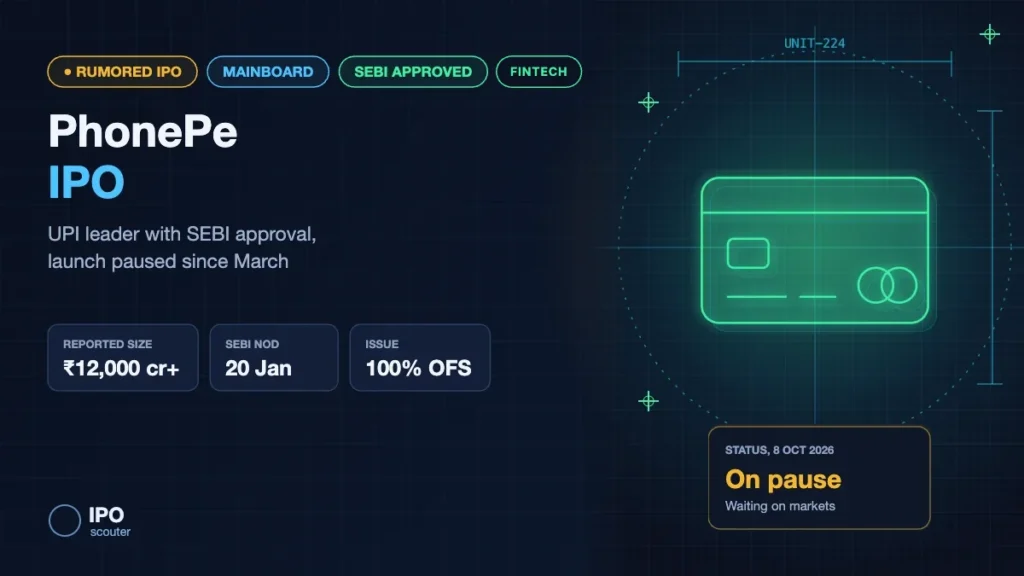
Jio Platforms IPO: Subscription Status, GMP Today and Review
Reliance Industries’ telecom and digital services arm and the parent of Reliance Jio Infocomm, India’s largest mobile operator with 524 million customers.
A dominant, highly profitable network with rising ARPU and a fresh issue that nearly wipes out net debt, priced at about 34 times earnings in a record-sized issue.
Our own view, not investment advice.
Key numbers
FY26, per the offer documents
| Revenue | ₹1,46,885 cr |
| Net profit | ₹30,064 cr |
| EBITDA margin | 51.9% |
| Customers | 524.4 million |
| ARPU (exit FY26) | ₹214 |
| P/E at upper band | About 34x |
IPO timeline
Bidding is open from 21 to 23 October 2026. By the end of day 2 the issue was 5.57 times subscribed, with QIBs at 13.29x, NIIs at 5.97x and retail at 1.54x. Allotment is expected on 26 October and listing on 28 October.
Held Reliance Industries shares on 14 October 2026? Read our Jio Platforms IPO shareholder quota guide: eligibility, record date, the same-PAN rule and how to apply in both the shareholder and retail categories.
The Jio Platforms IPO opened on 21 October 2026 and was 5.57 times subscribed at the end of day 2 (22 October), Business Standard reported, citing exchange data. QIBs had bid 13.29 times their portion, NIIs 5.97 times, the RIL shareholder quota 4.04 times and retail investors 1.54 times. The grey market premium was about ₹239 to ₹247 on 22 October (unofficial). Bidding closes on 23 October.
Jio Platforms, the telecom and digital arm of Reliance Industries, filed its red herring prospectus on 14 October 2026 and set a price band of ₹1,065 to ₹1,119 a share. Bidding runs from 21 to 23 October. It is an entirely fresh issue of up to 27 crore shares, worth about ₹30,213 crore at the upper band, which would make it the largest IPO in Indian market history, ahead of Hyundai Motor India in 2024.
The business behind it is very large and very profitable: revenue of ₹1.47 lakh crore and net profit of ₹30,064 crore in FY26, with an EBITDA margin near 52%. At the upper band, market estimates put the valuation at about ₹10.3 lakh crore, roughly 34 times FY26 earnings. The grey market premium is about ₹239 to ₹247, or 21% to 22% (unofficial, 22 October). Below we cover the final terms, the shareholder quota, the numbers and our Scouter Reading.
Jio Platforms IPO subscription status
| Category | Day 1 (21 Oct, end of day) | Day 2 (22 Oct, end of day) |
|---|---|---|
| QIB (excluding anchor) | 9.04x | 13.29x |
| NII total | 1.62x | 5.97x |
| Big NII (above ₹10 lakh) | 1.76x | 6.76x |
| Small NII (₹2 to 10 lakh) | 1.34x | 4.38x |
| Retail | 0.71x | 1.54x |
| RIL shareholders | 1.41x | 4.04x |
| Employees | 1.33x | 2.10x |
| Total | 3.04x | 5.57x |
Jio Platforms IPO subscription by category, day 2
Times subscribed at the end of 22 October 2026. Solid bar: day 2. Faint bar: day 1. White line: fully subscribed (1x).
Scale 0 to 14x. Figures change through the final day; this chart will be updated with day 3.
The book was fully covered within the first hour, on the back of QIB bids. By about 10:34 AM institutions had bid for roughly ₹17,804 crore of shares against ₹5,484 crore on offer to them (Business Standard), and by the close of day 1 their portion was 9.04 times covered. Across all categories investors bid for about 59.97 crore shares against 19.75 crore on offer; retail, at 0.71 times, was the only category still short. Day 2 brought broad-based demand. By the end of 22 October QIBs had bid 13.29 times their portion, non-institutional investors 5.97 times (big NII 6.76x, small NII 4.38x), the RIL shareholder quota 4.04 times, employees 2.10 times and retail 1.54 times, taking the total to 5.57 times, Business Standard reported, citing exchange data. In its QIB breakdown, domestic financial institutions bid for about 34.4 crore shares, foreign investors about 22.3 crore and mutual funds about 4.2 crore. By applications, about 54 lakh retail bids had come in by the evening of day 2 against roughly 71 lakh minimum lots (estimate). We will add the final day-3 figures as the exchanges publish them.
Jio Platforms IPO at a glance
| Detail | Jio Platforms IPO |
|---|---|
| Issue size | About ₹30,213 crore at the upper band (₹28,755 crore at the lower band) |
| Issue type | Fresh issue of up to 27 crore shares; no offer for sale |
| Price band | ₹1,065 to ₹1,119 per share (face value ₹10) |
| Lot size | 12 shares (₹13,428 at the upper band) |
| Retail maximum | 14 lots, 168 shares (₹1,87,992) |
| Shareholder reservation | Up to ₹2,500 crore for eligible RIL shareholders as of 14 October 2026 |
| Employee reservation | Up to ₹500 crore, at a ₹54 per share discount |
| Anchor round | 19 October 2026: ₹8,109.85 crore from 212 anchor investors at ₹1,119 |
| Bidding dates | 21 to 23 October 2026 |
| Allotment | 26 October 2026 |
| Refund and demat credit | 27 October 2026 |
| Listing | 28 October 2026 on BSE and NSE |
| Market cap at upper band | About ₹10.3 lakh crore (market estimate) |
| Lead managers | 19 book running lead managers, including Kotak Mahindra Capital, Morgan Stanley, BofA Securities, Goldman Sachs and JP Morgan |
| Registrar | KFin Technologies |
Because this is a fresh issue, all of the money goes to Jio Platforms rather than to existing shareholders. Reliance Industries owned 66.43% before the IPO, Meta’s Jaadhu Holdings 9.98% and Google 7.73%, with PIF, KKR, Silver Lake, Mubadala and General Atlantic among the other investors. The 27 crore new shares are about 2.9% of the post-issue share capital, so existing holders are diluted only slightly.
As a profitable company, Jio follows SEBI’s standard split for the net offer: up to 50% for QIBs, at least 15% for NIIs and at least 35% for retail investors. Check the final split in the RHP before you bid.
Jio Platforms IPO lot and amount calculator. One lot is 12 shares: ₹13,428 at the upper band of ₹1,119 (₹12,780 at ₹1,065). Retail bids go up to 14 lots (₹1,87,992); small NII starts at 15 lots (₹2,01,420) and big NII at 75 lots (₹10,07,100). Calculated from the confirmed price band and lot size.
Anchor result (confirmed, 19 October 2026): Jio Platforms allotted 7,24,74,066 shares at ₹1,119 each to 212 anchor investors, raising ₹8,109.85 crore before the issue opens, according to its stock exchange filing as reported by PTI. Half of these shares are locked in for 30 days from allotment and the rest for 90 days, so anchor investors cannot sell them on listing day.
The RIL shareholder quota explained
Up to ₹2,500 crore of the issue, about 2.23 crore shares at the upper band, is reserved for individuals and HUFs who held at least one Reliance Industries share in demat form on 14 October 2026, the RHP filing date. Shares bought after that date do not count. There is no discount in this category; the ₹54 discount applies only to employees.
The useful part is that an eligible RIL shareholder can bid up to ₹2 lakh, or 14 lots, in the shareholder quota and also place a separate bid in the retail or HNI category from the same PAN. Because the shareholder quota is a separate pool, it gives RIL holders a second, independent chance of allotment.
What Jio Platforms actually does
Jio Platforms is the holding company for Reliance’s telecom and digital businesses. Its main subsidiary, Reliance Jio Infocomm, is India’s largest mobile operator by customers, with 524.4 million at the end of March 2026 and 36.2 million net additions during FY26. About 268 million of those customers were on 5G. The group also runs home broadband, enterprise connectivity and a range of digital services.
Usage keeps climbing. Data traffic rose from 184.5 billion GB in FY25 to 241.4 billion GB in FY26, and average monthly data use per customer reached 42.3 GB in the last quarter of FY26, up from 33.6 GB a year earlier. Since 2020 the company has brought in Meta and Google as strategic investors, alongside a group of global funds.
The numbers behind the business
These figures are from the offer documents, in ₹ crore.
| ₹ crore | FY25 | FY26 |
|---|---|---|
| Revenue from operations | 1,28,218.4 | 1,46,885.3 |
| Net profit | 26,110.2 | 30,064.3 |
| EBITDA margin | Not disclosed | 51.9% |
| Net debt (31 March) | 45,273.4 | 27,579.2 |
| ARPU (exit quarter, ₹) | 206.2 | 214.0 |
What these numbers tell us, in plain language:
- Steady mid-teens growth at huge scale. Revenue grew 14.6% and profit 15.1% in FY26. That is unusual for a company of this size and comes from both more customers and higher revenue per customer.
- Very high margins. An EBITDA margin of about 52% reflects the economics of a scaled network. Capital spending on spectrum and 5G is the main use of that cash.
- Debt is falling fast. Net debt dropped from ₹48,440 crore in March 2024 to ₹27,579 crore in March 2026. Up to ₹27,500 crore of the IPO money will repay or prepay borrowings at Reliance Jio Infocomm, which would leave the group close to net debt free.
- ARPU is the lever. ARPU rose from ₹181.7 in FY24 to ₹214 by the end of FY26. Each further tariff increase flows largely to profit, which is why the market watches it so closely.
Jio Platforms IPO GMP today
Grey market dealers quoted Jio at around ₹160 a share in early October, before the price band was set, and at about ₹210 to ₹223 after the band was fixed on 14 October. On the morning of 21 October, as bidding opened, trackers quoted about ₹265 (IIFL, 10:37 AM) to ₹268 (IPO Premium). On the ₹1,119 upper band, ₹265 implies about ₹1,384, roughly 24% higher, or about ₹3,180 on one lot of 12 shares (calculated). On 22 October, day 2, trackers quoted a slightly lower ₹239 (12:15 PM) to ₹247, implying about ₹1,358 to ₹1,366, or 21% to 22% over the upper band (calculated, unofficial).
Treat this with care. The grey market is unofficial and unregulated, and for an issue of ₹30,213 crore it is tiny relative to the book, so a few trades can move the quote. In the past week, HD Fire Protect listed about ₹16 below its GMP-implied price and Vaibhav Vyapaar listed below its issue price despite a positive GMP. GMP is not a forecast of the listing price.
How to check Jio Platforms IPO allotment status
- Open the KFin Technologies IPO allotment page, or the BSE or NSE allotment status page.
- Choose Jio Platforms from the list of issues.
- Enter your PAN, application number or DP and client ID.
- Submit to see how many shares were allotted in each category you applied in.
The basis of allotment is expected on 26 October 2026, with refunds and demat credits on 27 October and listing on BSE and NSE on 28 October.
What to weigh before you apply
A fair, not cheap, price
At about 34 times FY26 earnings, Jio is priced as a high-quality compounder, not a bargain. With net debt nearly cleared by the issue, the enterprise value works out to roughly 13 to 14 times FY26 EBITDA. The case for paying that rests on continued ARPU gains and on new revenue from 5G home broadband, enterprise and digital services. We set these multiples against Bharti Airtel’s in Jio Platforms IPO valuation vs Airtel.
Fresh money with a clear purpose
Unlike many large IPOs, no shareholder is selling here. Almost all of the money goes to cutting debt, which lowers interest costs and should lift reported profit. That is a cleaner structure than an offer for sale, where the money leaves the company.
Regulation and competition
Telecom is a licensed, spectrum-dependent business. Tariff decisions, spectrum auctions and regulatory changes can move profits sharply, and the company relies on a small number of tower and fibre providers. Competition with Bharti Airtel keeps pricing disciplined but limits how fast tariffs can rise.
Strengths and risks
Strengths
- India’s largest mobile operator, with 524.4 million customers
- FY26 net profit of ₹30,064 crore, up 15%
- EBITDA margin of about 52%
- Fresh issue of up to ₹27,500 crore to repay debt; no OFS
- ARPU up from ₹181.7 in FY24 to ₹214
- Separate quota for RIL shareholders and a 35% retail share of the net offer
Risks
- About 34 times FY26 earnings at the upper band
- Record issue size needs very broad demand to price well
- Profits depend on tariff increases and spectrum costs
- Telecom licences and regulation can change
- Reliance on a few tower and fibre infrastructure providers
- A 20% GMP before opening raises the risk of disappointment
Scouter verdict: Jio Platforms is a dominant, cash-generating network with rising ARPU, and the fresh issue will leave it close to net debt free. The price, about 34 times earnings, already reflects much of that quality, and the record size means the listing will depend on how broad demand is. The grey market points to a solid listing; long-term investors are buying steady compounding rather than a bargain. This is our own view, not investment advice.
Your chances of getting an allotment
- Retail investors get at least 35% of the net offer, which at the upper band is roughly ₹9,500 crore, or about 71 lakh lots of 12 shares. That is far more lots than a typical mainboard issue.
- Every successful retail applicant gets at least one lot. At the end of day 2, retail applications (about 54 lakh) were still fewer than the roughly 71 lakh minimum lots available, so on those numbers every valid retail application would get one lot; day 3 bids can change this (estimate). If the retail book is oversubscribed, the minimum lot is drawn at random among valid applications.
- Eligible RIL shareholders can apply in the shareholder quota and in the retail category, which gives them two separate chances.
- Bidding for 14 lots does not improve your odds in the retail draw; separate PANs within a family do.
What to watch from here
- How the QIB book fills after anchors took ₹8,109.85 crore on 19 October
- Day by day subscription from 21 to 23 October, especially QIB and the shareholder quota
- Whether the GMP holds near ₹240 to ₹250 through the final day
- Allotment on 26 October through KFin Technologies
- After listing: ARPU, 5G customer growth and capital spending in the quarterly results
Jio Platforms IPO: frequently asked questions
The price band is ₹1,065 to ₹1,119 per share, with a lot size of 12 shares. One lot costs ₹13,428 at the upper band, and the retail maximum of 14 lots costs ₹1,87,992.
At the end of day 2 (22 October 2026), the issue was 5.57 times subscribed: QIBs 13.29x, NIIs 5.97x, retail 1.54x, RIL shareholders 4.04x and employees 2.10x, Business Standard reported, citing exchange data. Bidding closes on 23 October; allotment is expected on 26 October and listing on 28 October.
Grey market trackers quoted about ₹239 to ₹247 on 22 October 2026 (day 2), about 21% to 22% over the ₹1,119 upper band, slightly below the ₹265 to ₹268 quoted when bidding opened on 21 October. GMP is unofficial, can change quickly and is not a forecast of the listing price.
Individuals and HUFs who held at least one Reliance Industries share in demat form on 14 October 2026. Up to ₹2,500 crore is reserved, the maximum bid is ₹2 lakh, and eligible shareholders can also bid separately in the retail or HNI category.
It is entirely a fresh issue of up to 27 crore shares, worth about ₹30,213 crore at the upper band. Up to ₹27,500 crore will repay or prepay borrowings at Reliance Jio Infocomm, with the rest for general corporate purposes.
Allotment is expected on 26 October 2026. Check it on the KFin Technologies website or the BSE and NSE allotment pages using your PAN or application number.
Sources: SEBI public issue filings (RHP), BSE public issues, NSE IPO page, KFin Technologies (registrar) allotment page, Business Today, price band, 14 Oct 2026, Business Today, RHP filing and reservations, PSU Watch, issue structure, Kotak Neo, DRHP financials. Financials are from the company’s offer documents; the valuation is a market estimate.
Disclaimer: This article is for information and education only and is not investment advice. GMP is unofficial and data may differ between sources. Read the RHP and consult a SEBI-registered adviser before investing. Subscription data as of the end of day 2, 22 October 2026, 6:57 PM IST (consolidated NSE and BSE bid details); GMP as of the morning of 21 October 2026.
On this page
Key valuation
| Market cap (est.) | ₹10.3 lakh cr |
| P/E (FY26) | About 34x |
| EV/EBITDA (post-issue) | About 13 to 14x |
| EBITDA margin | 51.9% |
| Net debt (Mar 2026) | ₹27,579 cr |
| Debt repayment from IPO | Up to ₹27,500 cr |
| OFS | Nil |
IPO alerts
Get GMP moves, subscription updates and allotment links the moment they change.
Follow @ipoScouter on X